
Big city, flat ground, heavy rain
Barndominium Builders in Houston, TX
Steel and post-frame homes planned around Gulf Coast clay, bayou flooding and the way land is actually regulated here.
- Free on-site estimates
- Written, line-item pricing
- County permit and septic research included
Building a Barndominium in and Around Houston
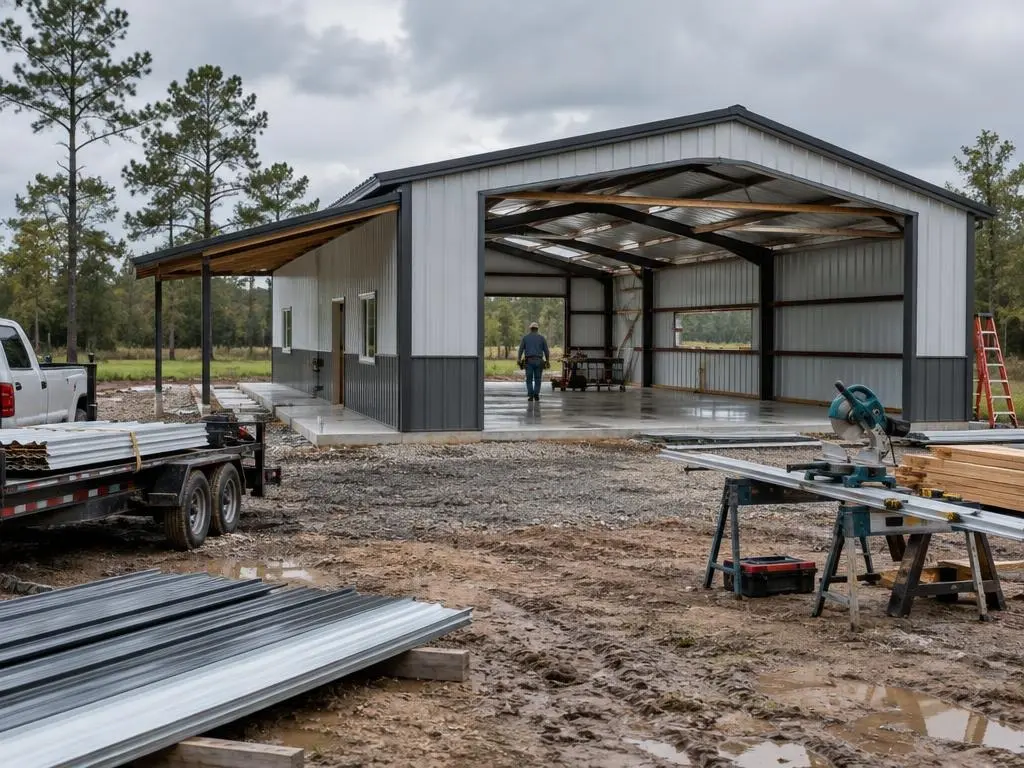
Barndominium builders working in Houston deal with a city that is unlike most of Texas on paper and very much like the rest of the coast underfoot. Houston counted 2,304,580 people in the 2020 census, spreads across Harris County with pieces in Fort Bend and Montgomery counties, and sits on the Gulf coastal plain at roughly 50 feet above sea level downtown and about 150 feet at its highest point in the far northwest. That flat, low ground shapes almost every decision on a barndo: how high the slab sits, how the lot drains and how the foundation handles clay.
No zoning does not mean no rules
Houston is the largest city in the United States without formal zoning. Voters turned down separate residential and commercial districts in 1948, 1962 and 1993. That surprises people who expect a metal-sided home to be easy to place anywhere inside the city. In practice, land use is steered by legal covenants and city rules on things like minimum lot size and parking. Private deed restrictions can cover exterior materials, outbuildings and roof lines, so a barndominium on an infill lot can be blocked by a private covenant even where the city itself would not object. We read the restrictions on a lot before drawing a single wall.
Flood rules that set your floor height
In 2018 Houston City Council passed a floodplain rule requiring homes to be raised two feet above the 500-year floodplain. It passed on a 9 to 7 vote and it matters for barndos because a slab-on-grade steel building is the most common way to build one. Raising a slab means fill, a taller grade beam, or a stem-wall foundation, and each choice changes the look of the porch and the shop doors. We set the finished floor first and design the building around it.
The reason is plain from the record. Tropical Storm Allison in June 2001 dropped up to 40 inches of rain. Hurricane Harvey in August 2017 brought more than 50 inches to some areas. The Memorial Day flood of 2015 delivered about 12 inches in 10 hours, and an April 2016 storm added 17 inches. Imelda in 2019 and Beta in 2020 followed. Four major bayous run through the city, with Buffalo Bayou crossing downtown and White Oak, Brays and Sims bayous feeding into the system, and the surrounding prairie drains toward town.
Clay under the slab
Houston's surface soils are low-permeability clay-silt prairie soils over unconsolidated clays, clay shales and poorly cemented sands. Across much of Southeast Texas between the Colorado and Trinity rivers you find the Lake Charles series, a very slowly permeable clay that the USDA describes as highly shrink-swell. When it dries it cracks 1 to 5 centimeters wide and 30 centimeters or deeper, and those cracks stay open 60 to 90 days in most years. For a barndominium that means:
- a post-tensioned or heavily reinforced slab sized for movement, not a basic shop slab
- grading that keeps roof runoff from long eave lines well away from the foundation
- gutters and downspouts planned with the drainage, because a big metal roof sheds a lot of water fast
Heat, storms and the metal envelope
Houston has a humid subtropical climate. Summer highs reach or pass 90 degrees on an average of 106.5 days a year, and annual rainfall at Intercontinental Airport averages 51.84 inches. Spring supercells sometimes produce tornadoes even though Houston is not in Tornado Alley. For a steel or post-frame home that points to closed-cell spray foam or a well-detailed vapor control layer against condensation, HVAC sized for real humidity loads, and roof and wall panels fastened to the wind design the engineer sets for the site.
City lot or acreage?
Many Houston-area barndos end up on land outside the city, where lots are larger and a shop bay makes sense. Inside the city a barndominium can still work on a suitable lot when the covenants allow it. Either way we start with the land: restrictions, flood map, soil and utilities. Call (832) 850-5283 or
.Houston Site Facts That Shape a Barndo
- No formal zoning. Houston is the largest U.S. city without formal zoning; voters rejected land-use districts in 1948, 1962 and 1993, so covenants and deed restrictions do much of the work.
- Floor height rule. A 2018 City Council rule requires homes to be raised two feet above the 500-year floodplain.
- Shrink-swell clay. The Lake Charles clay series common in Southeast Texas is very slowly permeable and cracks 1 to 5 cm wide when dry, with cracks open 60 to 90 days in most years.
- Record rainfall. Hurricane Harvey dropped more than 50 inches on parts of the area in 2017; Allison brought up to 40 inches in 2001.
- Hot season. Houston averages 106.5 days a year at or above 90 degrees F.
Houston Questions
Can I build a barndominium inside Houston city limits?
Often yes, because Houston has no formal zoning. The real test is the lot's deed restrictions and the city's flood elevation rule, which we check before design starts.
How high does my slab need to be in Houston?
Inside the city, homes must be raised two feet above the 500-year floodplain under the 2018 rule. The site's flood data sets the exact finished floor.
Will Houston clay crack a barndo slab?
It can move a slab that isn't designed for it. We plan a foundation for shrink-swell clay and grade the lot so water runs away from the building.
Do you build outside Houston too?
Yes. We build on acreage across the counties around the city, including Montgomery, Waller, Fort Bend, Brazoria and Liberty.
Free Estimates in Houston, TX
Talk through your Houston lot or acreage.
Barndominium Builders Near Houston
- Barndominium Builders in Katy, TX
- Barndominium Builders in Cypress, TX
- Barndominium Builders in Tomball, TX
- Barndominium Builders in Magnolia, TX
- Barndominium Builders in Conroe, TX
- Barndominium Builders in Montgomery, TX
- Barndominium Builders in Willis, TX
- Barndominium Builders in Cleveland, TX
- Barndominium Builders in Dayton, TX
- Barndominium Builders in Liberty, TX
- Barndominium Builders in Crosby, TX
- Barndominium Builders in Baytown, TX
- Barndominium Builders in Pearland, TX
- Barndominium Builders in Alvin, TX
- Barndominium Builders in Angleton, TX
- Barndominium Builders in Needville, TX
- Barndominium Builders in Rosenberg, TX
- Barndominium Builders in Richmond, TX
- Barndominium Builders in Fulshear, TX
- Barndominium Builders in Sealy, TX
- Barndominium Builders in Hempstead, TX
- Barndominium Builders in Waller, TX
- Barndominium Builders in Brookshire, TX
- Barndominium Builders in Santa Fe, TX
- Barndominium Builders in Splendora, TX